
Visiting Our Church
Whether it is your first time in an Orthodox church or you are visiting from another parish, welcome home.
Located in the heart of Boise, we are a warm, welcoming family of Orthodox Christians who embrace visitors and inquirers from all traditions, and people from all backgrounds. The parishioners of Saints Constantine and Helen look forward to welcoming and meeting you.
When
Sunday Orthros (Matins) at 8:45 am
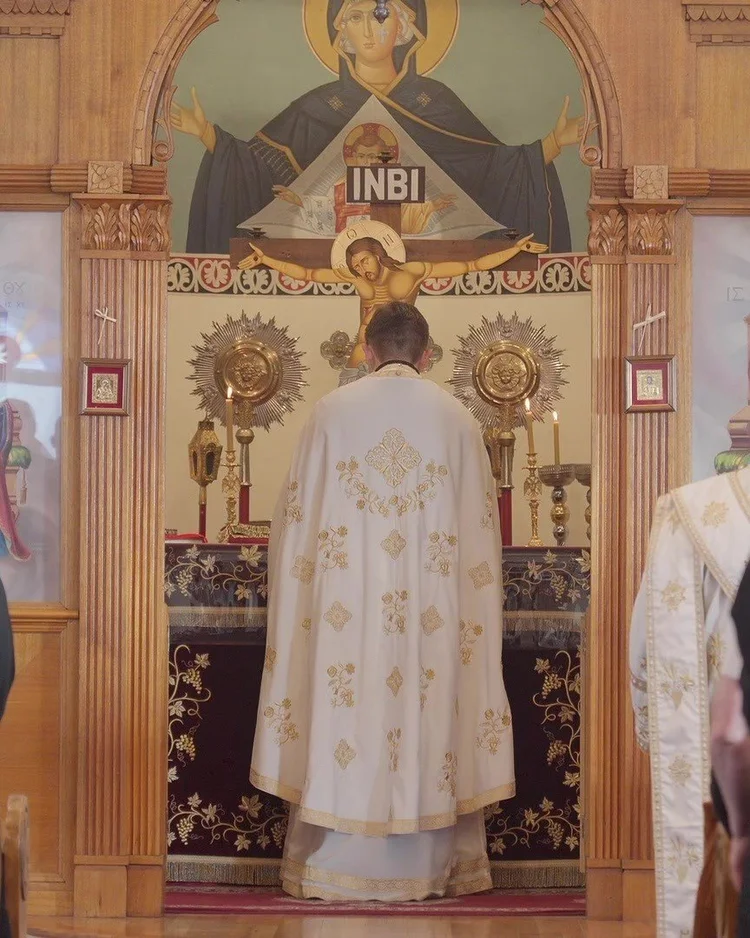
Sunday Divine Liturgy at 10:00 am
Saturday Great Vespers at 5:00 pm
See the full calendar for feast days, Bible study, and confession times.
What to wear
Come as you are. Most people dress modestly, as they would for any church, but there is no dress code and you will not be turned away.
What to Expect
Your first visit to an Orthodox liturgy can seem unfamiliar and even a little overwhelming, especially if you come from a Protestant or non-Christian background. Just remember that many of us have been where you are, and we love to help. We are all here to worship, and we are glad that you have joined us.
The most important thing you can do in liturgy is to be present. Rather than focusing on imitating the actions of the people around you, we recommend that you simply enter into worship and focus on God’s beauty and majesty as revealed in the service. You will get the hang of the actions soon enough.
Frequently Asked Questions
What is a liturgy, and how long is it?
The Sunday morning service at an Orthodox parish is called the Divine Liturgy. There are four different liturgies celebrated throughout the year. The Divine Liturgy that we typically celebrate was written by Saint John Chrysostom of Constantinople around 400 AD, so much of today’s liturgy is over 1,600 years old.
A typical Sunday liturgy lasts about 75 to 90 minutes. The first half is focused on hymns, scripture, and the sermon, and the second half is focused on the consecration and distribution of the Eucharist. At Saints Constantine & Helen, we also celebrate a service called Matins or Orthros just before the Divine Liturgy. Orthros lasts about an hour. Feel free to come to Orthros, or arrive just before the Divine Liturgy starts.
We stand when we pray
Various Orthodox traditions allow for those able to stand or sit during different parts of the service. At Saints Constantine & Helen, there are a few times where it is important to stand, if possible: during the procession of the elements through the congregation, during the reading of the Gospel, the reciting of the Creed and the Lord’s Prayer, and during the distribution of the Eucharist. Otherwise, feel free to remain seated if you need to, or to stand along with the congregation. It may feel like there is a lot of up and down, but you will get the hang of it pretty quickly.
Orthodox people venerate
When we first come into the church, we light a candle and we kiss (venerate) the icons. You may also notice that some kiss the chalice after receiving Holy Communion, and when the priest comes in procession some touch the edge of his vestments as he passes by. The acolytes kiss his hand when they give him the censer, and we all line up to kiss the priest’s hand at the end of the service as we receive the blessed bread.
When we talk about “venerating” we simply mean showing reverence. The reason for kissing the hand of the priest has to do with our understanding that during the liturgy the hands of the priest are Christ’s hands. The priest also holds in his hands the Body of Christ while he prepares the chalice. It is also through the laying on of hands that ordinations are done by the bishops, a practice that goes back to the Apostles.
People make the sign of the cross
We sign ourselves whenever the Trinity is invoked, whenever we venerate the cross or an icon, and on many other occasions in the course of the Liturgy. People are not expected to do everything the same way, however. Some cross themselves three times in a row, and some finish by sweeping their right hand to the floor.
I’m not Greek. Am I still welcome?
Yes! Yes! Yes! Our services are almost entirely in English, with some Greek (and occasionally other languages) woven in. We are a parish under the Greek Orthodox Archdiocese of America, and we have many families in our community with Greek heritage, but we are first and foremost a family of Orthodox Christian faithful with many different ethnic and faith backgrounds.
Am I allowed to take Communion?
Those who have been baptized as Orthodox Christians or have been chrismated (anointed with holy oil, or chrism, and received into the Church) may receive Communion if they are spiritually prepared. We handle the Eucharist with great gravity, which is why we guard it from common access: we believe it is truly the Body and Blood of Christ.
Only Orthodox Christians may receive Communion, but anyone may have some of the blessed bread (antidoron) offered at the conclusion of the liturgy. As we file past the priest, we come upon a container of blessed bread. People take portions for themselves and for visitors and non-Orthodox friends around them. If someone hands you a piece of blessed bread, do not panic; it is not the Eucharistic Body. It is a sign of fellowship.
What denomination is Orthodoxy?
Orthodox Christianity pre-dates modern denominations, and together with the Roman Catholic Church comprised the original Christian Church for the first millennium after Christ’s Resurrection. Orthodoxy encompasses the fullness of the Christian faith as expressed in scripture and the teachings of the first Seven Ecumenical Councils.
The Orthodox faith has been handed down and preserved from the time of the Apostles through apostolic succession. Every bishop of the Orthodox Church can trace his ordination and spiritual lineage back through time directly to Christ’s Apostles, and that succession continues to the priests and deacons whom the bishops ordain.
Originally, the early Christian Church was led by five patriarchs in Jerusalem, Antioch, Constantinople, Alexandria, and Rome. These patriarchs, through the guidance of the Holy Spirit, made decisions together in council and operated as one until 1054 AD, when the Great Schism occurred. The four Eastern patriarchs remained in unity, but there was a separation from the bishop, or pope, of Rome. Five hundred years later, the Protestant Reformation resulted in a further split in the West. The result in history is the existence of three branches of Christianity: Eastern Orthodoxy, Roman Catholicism, and Protestantism with its many denominations.
Why are there so many different Orthodox churches?
For the first thousand years of Christian history, the Church was united: one Church with five patriarchal centers living in full communion with one another. For the nearly thousand years since the Great Schism, the four Eastern patriarchal centers have remained in full communion and virtually identical in practice to the Apostolic Church since New Testament times.
In the United States, a very young country, immigrants from all over the world established churches according to their ethnic backgrounds, still under the oversight of the bishop of their country of origin. Thus there exist Russian, Greek, Antiochian, and other Orthodox churches in our neighborhoods, but we all share the same faith. Currently the largest American jurisdictions are the Greek Orthodox Archdiocese, the Orthodox Church in America (Russian roots), and the Antiochian Archdiocese (Arabic roots). The liturgy is substantially the same in all, though there may be variation in the language used and the type of music.
Do you believe in the Scriptures?
Absolutely! We believe the Bible to be the inspired word of God. The Bible and Holy Tradition are the two sources of authority in the Church. Holy Tradition is defined as the working of the Holy Spirit in the Church over time. In fact, the New Testament as we know it today was not officially recognized until the early fourth century, when, guided by the Holy Spirit, the 27 books of the New Testament were canonized. Essentially, Holy Tradition within the Church gave birth to the New Testament.
Hymnology draws us to pray
At Saints Constantine & Helen, the choir is meant to lead the people in congregational singing. Traditionally, hymns are sung a cappella, although many Orthodox churches in America use organs as well.
There are paintings everywhere!
When you attend an Orthodox church for the first time, you will notice paintings on the walls called icons. People are sometimes confused by Orthodox icons because of a misunderstanding of the second commandment (Exodus 20:4). However, when we learn what icons are and what they mean, we can appreciate how vital they are to our relationship with God and His Saints. As windows to heaven, they act as guideposts on our way to the Kingdom of Heaven.
The three doors
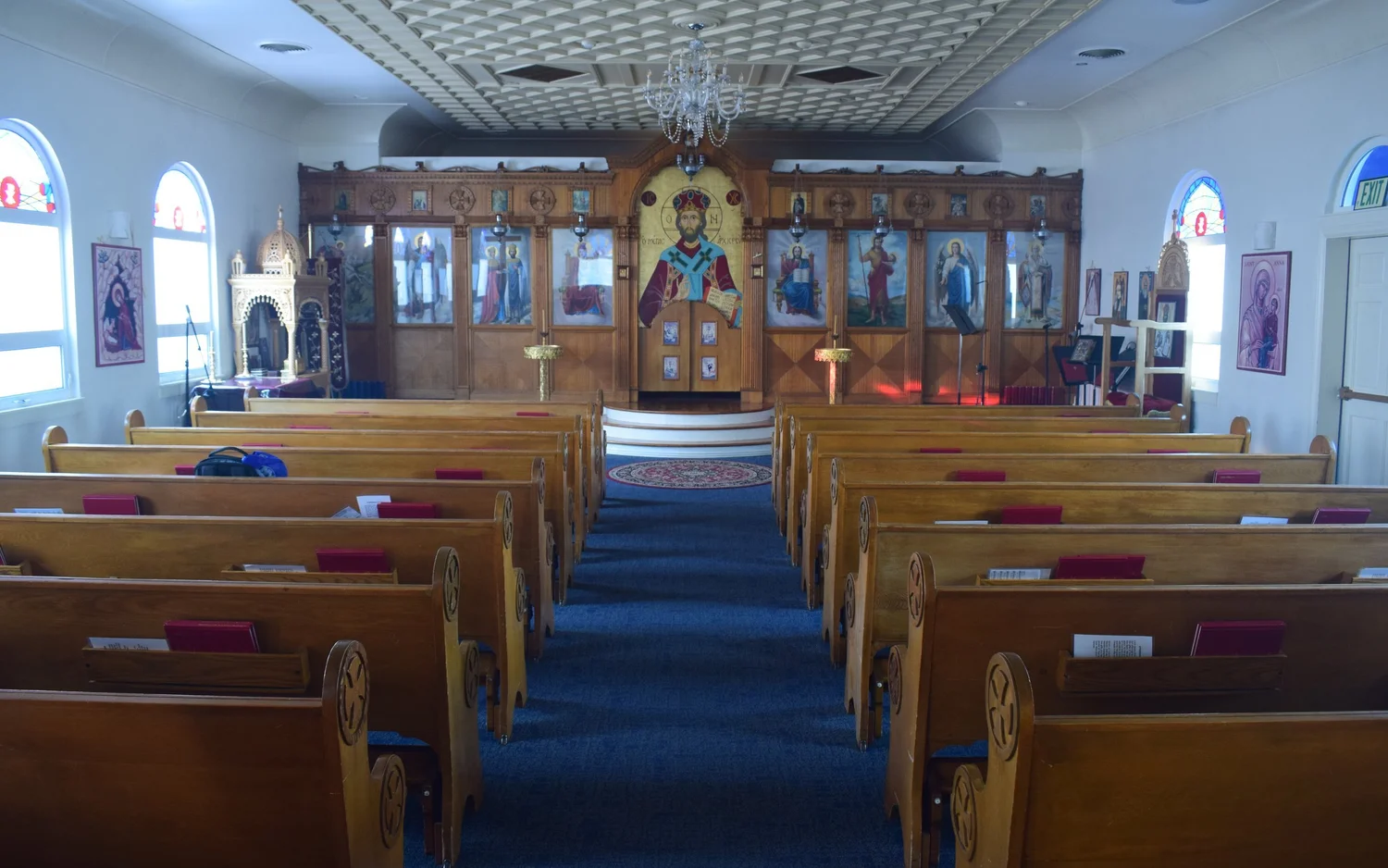
Every Orthodox church has an iconostasis before its altar. “Iconostasis” means “icon-stand,” and it can be as simple as a large image of Christ on the right and a corresponding image of the Virgin and Child on the left. This basic set-up creates three doors. The central one, in front of the altar itself, is called the “Holy Doors” or “Royal Doors,” because there the King of Glory comes out to the congregation in the Eucharist. Only the priest and deacons, who bear the Eucharist, use the Holy Doors. The openings on either side have doors with icons of angels; they are termed the “Deacon’s Doors.” Altar servers and others with business behind the altar use these, although no one goes through any of the doors without an appropriate reason.
The Virgin Mary
A constant feature of Orthodox worship is veneration of the Virgin Mary, the “champion leader” of all Christians. We often address her as “Theotokos,” which means “Mother of God.” In providing the physical means for God to become man, she made possible our salvation. We honor her, as Scripture foretold (“All generations will call me blessed,” Luke 1:48). When we sing “Through the intercessions of the Theotokos, Savior, save us,” we do not mean that she grants us eternal salvation, but that we seek her prayers for our protection and growth in faith. The saints are not dead, after all, just departed to the other side. Icons surround us to remind us of all the saints who are joining us invisibly in worship.
Based on an article by Frederica Mathewes-Green, adapted for our parish.
Still Have Questions?
Call the parish office at (208) 345-6147 or send us a note. We are happy to answer questions, arrange a visit, or introduce you to our priest.